
Celebrating 300th Newsletter 🎉
Reflections on writing, analytics, and building something that lasts.

Welcome to the Data Analysis Journal, a weekly newsletter about data science and analytics.
If you missed the January posts, here’s the roundup:
Anticipating 2026: Top Trends in Analytics - The shifts shaping analytics, how the analyst role is changing, and what to do now to be ready for 2026.
What “Normal” Looks Like: A Guide to Baselines - What baselines are, how to choose and calculate them, the main types (static, rolling, seasonal, cohort-based), and the mistakes that make teams measure the wrong thing.
KPI & Metrics Checklist - A fast, shareable metrics reference for product planning, reviews, and stakeholder conversations.
🔥 Bonus: The Analytical Skills No One Teaches You - My guest post in SeattleDataGuy on estimation, root-cause analysis, metrics, and the skills most data pros are expected to have, but rarely get taught.
This week marks the 300th newsletter since I started writing my Data Analysis Journal 🎉🎉🎉. My little personal blog became very public, with 30K readers and 60K monthly publication views.
As I pour champagne to celebrate this mini-anniversary (not now, but maybe on Friday), I wanted to make this issue a little special and take a moment to reintroduce myself, this substack, and share my reflections and learnings from this long writing journey.
I keep getting questions about whether blogging helps you land a job, increase visibility, find customers, scale a business, or even become a sustainable source of income. The answer is yes to all of the above. But it comes with a cost that often outweighs everything else.

If you just joined - welcome
If you’re new here - welcome! I’m Olga, a data scientist and analyst, and I write here about things people make me do at work: measurement, experiments, metrics, funnels, retention, subscriptions, and all the messy real-world tradeoffs behind dashboards. Most of it is fun - I get to do puzzles for a living!
I’ve led data analytics at fast-growing companies and Fortune 500 teams, setting up and owning the analytics function end-to-end. Today I work with 25+ products and apps across B2C and SaaS. I don’t do it alone - I have a team of wonderful data scientists and data engineers. (And I’m hiring!)
Everything here is written by me and reflects my perspective. No paid promotions. No sponsorships. I get plenty of requests to run ads, but I’d rather keep this place independent. If I mention a tool, it’s because I genuinely use it or think it’s worth knowing, not because someone paid for it.
Why I write this newsletter
Document my work (and make it reusable).
Over the years, I’ve built checklists, playbooks, templates, snippets, calculators, and frameworks. They used to be all over the place. This newsletter is my central library, something I can revisit myself and share so readers can reuse.
Make analytics feel real and applied.
I believe that our academia is broken. Today, we use less than 10% of what we learn at school, and it gets worse. Tools change faster than most programs can keep up, so many new practitioners arrive without the fundamentals. I write to show what data analysis looks like in practice - the projects, decisions, tradeoffs, and mistakes that never make it into tidy case studies.
Bring classic analysis back.
AI is making analytics “cool” again and putting it back in the spotlight. But before this wave, analytics was often treated as a stepping stone to data engineering or ML. I want to pull people back to the basics, enjoy real analysis, and recognize it as the foundation underneath experimentation, ML, dashboards, and strategy.
Stay ahead of the noise.
We live in a flood of new tools, features, and releases - most wrapped in the usual AI buzz. A lot of it is noise, but not all. Here, I write about what I think matters most and what shapes where analytics is headed.
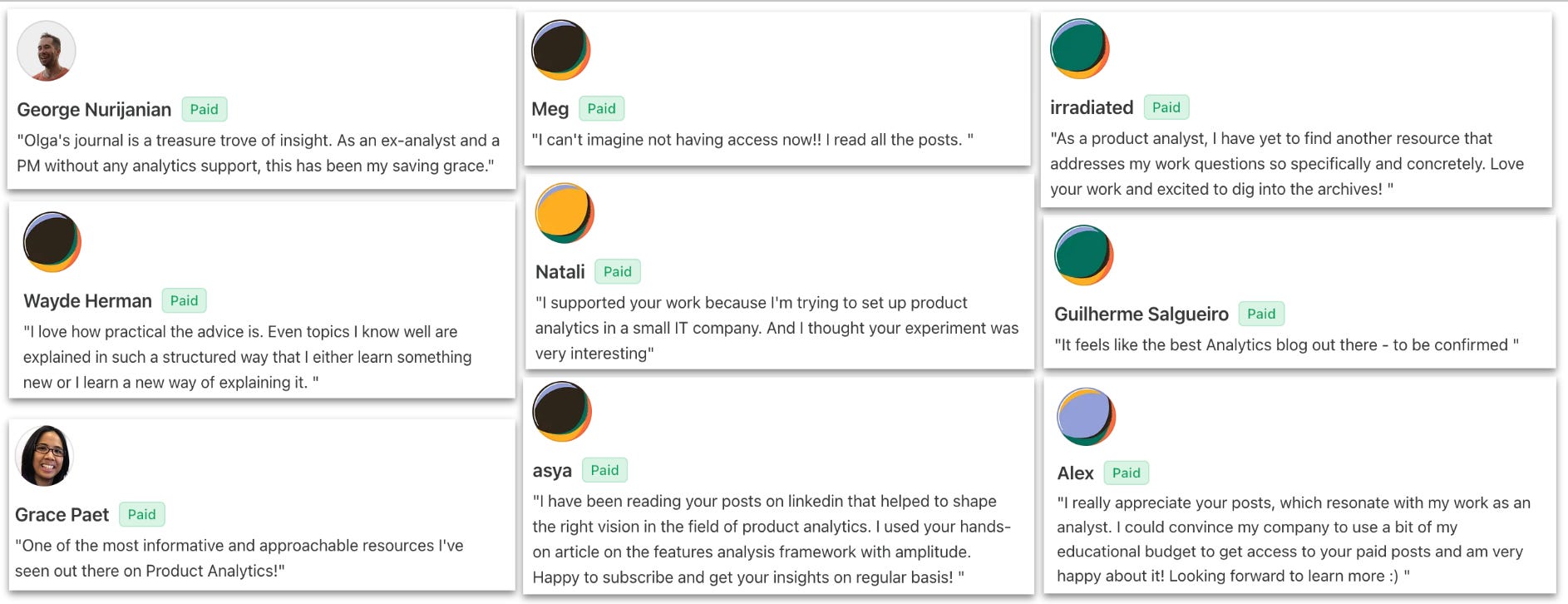
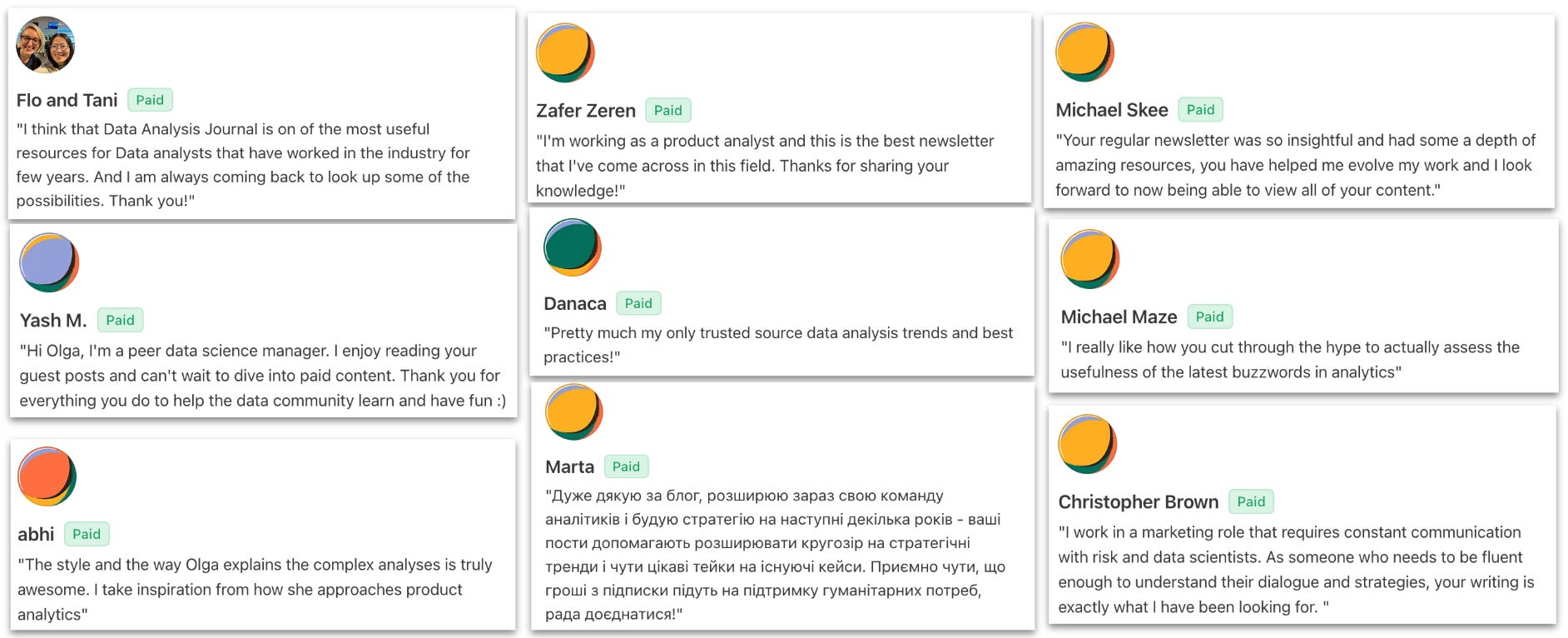
😍 What readers say
Reflections on years of blogging
I loved Lenny’s reflection on his 500K: Ten lessons learned from building this newsletter. I could restate the same points, but he said them better than I ever could, and I agree with every one of them. If you’re struggling to grow a newsletter or considering starting one, it’s a must-read.
For my own newsletter, and for anyone writing or thinking about writing in data and analytics, here are my 10 lessons from the trenches:
1. Quantity over quality doesn’t work anymore
Every content-creation coach will tell you that publishing frequency and consistency outweigh quality. That was true for me, too. When I started my newsletter, there were fewer than 30 analytics blogs, and that strategy somewhat worked.
Today, more than 45,000 authors write about data on Substack, and even more do so elsewhere.
Now you need high-quality, evergreen reads just to maintain growth. Quantity over quality doesn’t work anymore. You have to sustain both frequency and high-value content for a long time before you start seeing meaningful growth.
2. Less is more
“I would have written a shorter letter, but I did not have the time.”
It takes skill, time, and solid knowledge to condense the topic. I have to pack causation analysis or a regression deep dive, along with SQL code and examples, and all the details into the “newsletter” short format, and expect that readers will learn it in the whole minute they spend reading the weekly email. How would someone do this?
The tighter and more structured the piece, the better it performs. Readers don’t come for storytelling or entertainment. They’re looking for a formula, a table, or a clear takeaway they can use between meetings. Keeping it short and precise helps both of us.
3. 90% of writing is research
The visible part of writing is the final draft. The invisible part is everything that comes before it. For most pieces I publish, the writing itself is the smallest slice of the work that doesn’t take much. The bulk of the time goes into research - reading papers and docs, revisiting old analyses, checking with stakeholders if I can use or reference this or that, validating assumptions, re-running numbers, and checking whether a claim or hypothesis actually holds up outside a single example.
Almost for every publication, I send out drafts for review to peers or experts to get their opinion or check. All of this in a very short turnaround. And it’s hard to keep it all interesting to read but unbiased, be candid, but constructive. Especially when you love and live in this topic.
4. Go paid early
I didn’t launch paid subscriptions until I had over 1,000 subscribers. It didn’t feel right at first, and I thought I needed to pivot the content and format before charging. Looking back, now that I understand my readers better, I should have done it sooner.
After I went paid (and upgraded the content), open rates increased, the same posts received more reads, the newsletter was taken more seriously, and, most importantly, I took it more seriously.
A paid newsletter works a lot like a gym membership. People don’t pay because they’ll use it a lot every day. They pay to stay committed. Subscribers won’t read every issue or try every tool I share. But they show up when they need it, and the steady exposure to concepts, vocabulary, and trends compounds over time, even if it’s just skimming an email on a bus ride.
5. Your audience isn’t you
I live in a bubble, in a place where kids are born knowing SQL and tech slang and acronyms are just how people talk. It took me an embarrassingly long time to realize that many analysts who land on my pages don’t know what LTV, GTM, or RDBMS means, and that what I do is pretty niche. Not in San Francisco, but in most places, it is.
As my newsletter has grown, I’ve gotten more questions about abbreviations and slang, and requests to explain concepts in simpler terms. That’s how my one-pagers were born: the KPI & Metrics Checklist, A/B Test Checklist, or refreshers.
Analytics is cross-functional, and data professionals come from every kind of background. It’s easy to assume we all use the same tools, share the same context, and speak the same language, but a large share of your readers won’t. Now I start every publication with a short intro: who it’s for, and what problem it’s meant to solve. And I default to clearer words when they don’t sacrifice accuracy, e.g., experimentation instead of “A/B test”, cohort or group instead of “cluster”, audience instead of “sample”, average instead of “mean”, and so on. Even with that, I still sometimes get feedback that I’m too technical. At which point should I call a database “server of secrets” or “nerd pantry”?
6. Start niche, then broaden
There are millions of blogs and newsletters now, and yet, there’s still room and demand for better content. Even with 45K+ authors writing about data, code, and tech on Substack, I couldn’t find a trusted newsletter that consistently goes deep on marketing analytics, ROAS mechanics, mobile store ranking dynamics, or the real measurement tradeoffs you run into in practice. The same gap shows up in topics like forecasting and clustering. Most writing stays too high-level to be usable, repeats what everyone else already said, or, worse, makes confident claims with no research or context behind them.
That gap is the opportunity. You earn your first 100–1,000 readers by being unapologetically specific. But once you grow more, the constraints change. The niche doesn’t have to change, but the on-ramp does. To keep growing, you need to define terms, add context, and tie your niche lessons to problems a broader audience actually has, without losing the sharp point of view that brought people in the first place.
The more you grow, the more you need to generalize the framing and accessibility while keeping the core niche intact.
7. Maintaining a newsletter takes time
When you go paid, your biggest concern is whether you can consistently ship high-quality content with committed frequency. But content is only part of the work. You also end up handling taxes, invoicing, refund requests, group subscriptions, and general support, and that can take a surprising amount of time. Many of my subscribers expense the newsletter, so I get requests for invoices, custom invoice details, and verification letters.
Substack covers some of this, but not all, or sometimes it gets it wrong (for example, not matching a subscriber across different emails). When I decided to go paid, I was thinking only about the writing. I didn’t account for the extra hours of operations and support.
8. Newsletters build credibility, not instant leads
After I shared my story about pivoting to consulting and advising, I got a lot of questions about whether the newsletter brings in clients, and whether it makes sense to start one for leads.
In my case, most of my larger projects didn’t come from the newsletter. About 90% came through referrals and word of mouth - former coworkers, stakeholders, clients, and partners.
For a newsletter to generate meaningful inbound, it likely needs to be big. That’s hard when you’re niche, and it usually takes years to get there organically. A newsletter can absolutely increase visibility and credibility, but I wouldn’t count on it becoming a reliable lead source in the first few years, unless you’re pairing it with outbound.
What consistent publishing does do, reliably, is keep you sharp and proficient. You get better at explaining, you stay current, and you build a body of work you can point to. And yes, your English improves too.
9. Consistency compounds (but not how you think)
If you publish consistently in a niche for long enough, the audience you attract changes in fairly predictable waves. Here’s what the milestones often look like:
First 100 readers: your inner circle - coworkers, friends, and people who already know you.
100 to 1,000: students and career switchers, beginners looking for tutorials, examples, and step-by-step guides.
1,000 to 10,000: builders and operators - mostly founders, agencies, and researchers looking for benchmarks, case studies, reviews, and practical feedback.
10,000+: senior practitioners, team leads, executives, and experienced analysts looking for best practices, strategy, and tooling decisions.
That was roughly my trajectory. And as the newsletter grew, it became harder to deliver value to everyone at once. Last year, I stepped back from SQL/Python tutorials and one-off EDAs to double down on subscription analytics, ROI measurement, forecasting, and critical thinking, content that better matches where the audience is now.
10. Balancing burnout with excitement
I’ve been publishing weekly since the beginning, and I haven’t missed a week yet. Ever.
Imagine writing on a deadline every week for 5 years without sick days, vacations, holidays, work deadlines, or anything else getting in the way. You have to really love what you do and truly believe in the mission you’re on.
This tiny newsletter taught me to be fast and productive, but it comes with the cost of burnout. And there’s no finish line in sight - most of my subscribers are on annual plans, so I’ve basically committed to writing indefinitely, at least until one day I run out of readers?
And then something resets the whole equation: you meet someone randomly, they recognize your name, pull out their phone, and show you the “Olga” folder in their inbox. That’s when it hits you how real and fulfilling this is, and why it’s still worth doing.
🔥 Top 10 popular publications
I want to thank everyone who’s here, whether you read regularly, once in a while, have been a paid subscriber, or forwarded a post to a colleague - thank you ❤️🥹.
Thank you for supporting my writing, for caring about data and analytics, and for coming along for the ride. Analytics is a demanding field. It keeps changing, and learning how to navigate it is hard and also genuinely exciting.
Congrats on 300, Olga. Your experience is more useful than many "how to grow your newsletter" guides I've seen. These lessons come from 300 issues, and it shows. Especially the part about research being 90% of the work.
Congratulations!